
Generative AI Reshaping the Gaming Landscape
Lead article in VentureBytes Edition #97 - July 2023
You can download the full 97th edition of VentureBytes at our website:

Generative Artificial Intelligence (AI) is rapidly changing the gaming industry. In addition to increasing efficiency in game development and improving accessibility, the biggest impact of generative AI is likely to be on in-game content.
Games are complex and a huge entertainment market. Roughly 3.2 billion players generated $184.4 billion in annual revenue in 2022, according to Newzoo, a leader in video games and gamer data. Given the size, the gaming market is ripe for disruption by generative AI.
The cost of creating games is a major limiting factor. Roughly 40% of the total cost goes toward creating art assets, underscoring the significance of leveraging generative AI tools and services. Particularly, the remarkable capability of the technology to assimilate patterns, structure data, and swiftly generate fresh 3D content, all while significantly reducing costs. According to PwC, the value of integrating generative AI into gaming could be worth up to $321 billion by 2026.
Drawing parallels with prominent online platforms such as Spotify (audio), Instagram (photos), and YouTube (videos) allows us to envision the impending revolution in in-game content production due to generative AI. Just as these platforms revolutionized their respective industries by allowing users to generate content, generative AI promises to do the same within the gaming landscape. Comparing Red Dead Redemption 2, one of the most detailed games, with Microsoft Flight Simulator offers an idea of how generative AI has transformed gaming. The former costs $500 million and took almost eight years to build, while the latter – a far more detailed and enormous game – was built by training an AI model to create a 3D version of the earth from 2D satellite images. Blackshark.ai, Microsoft’s partner for the game, used its AI technology to display the entire 197 million square miles of Earth’s surface in 3D – with over 1.5 billion photorealistic buildings – giving users an unprecedented immersive 3D flight experience and the largest open world in the history of video games.
In addition to game studios, the potential transformation of the gaming ecosystem by generative AI opens opportunities for generative AI start-ups as well. Respeecher, for instance, specializes in AI voice augmentation technology. Developers can use Respeecher’s Voice Marketplace to create custom voice content that fits the tone and style of their game, resulting in a more immersive and engaging experience for players. Expanding beyond voice augmentation, start-ups like Stability AI have harnessed generative AI to expedite the creation of visually stunning images. Traditionally, developing high-quality graphics for games was a time-consuming process that could take weeks or even months. However, with Stability AI’s generative algorithms, game developers can generate captivating images within minutes or hours. Another noteworthy start-up in this space is California-based Scenario. Recognizing that each game possesses a distinct visual aesthetic, Scenario offers game developers the ability to create their own image generators specifically tailored to their game’s unique style. Similarly, Rosebud AI also offers AI-generated game assets for game development.
A generative AI-enabled drop in time and cost of the in-game user-generated content is another factor propelling the adoption of generative AI. According to ARK Invest, text-to-3D model costs have plummeted by almost 99% in the past year. Some developers have even witnessed a 120:1 reduction in their time to generate concept art for a single image within a game.
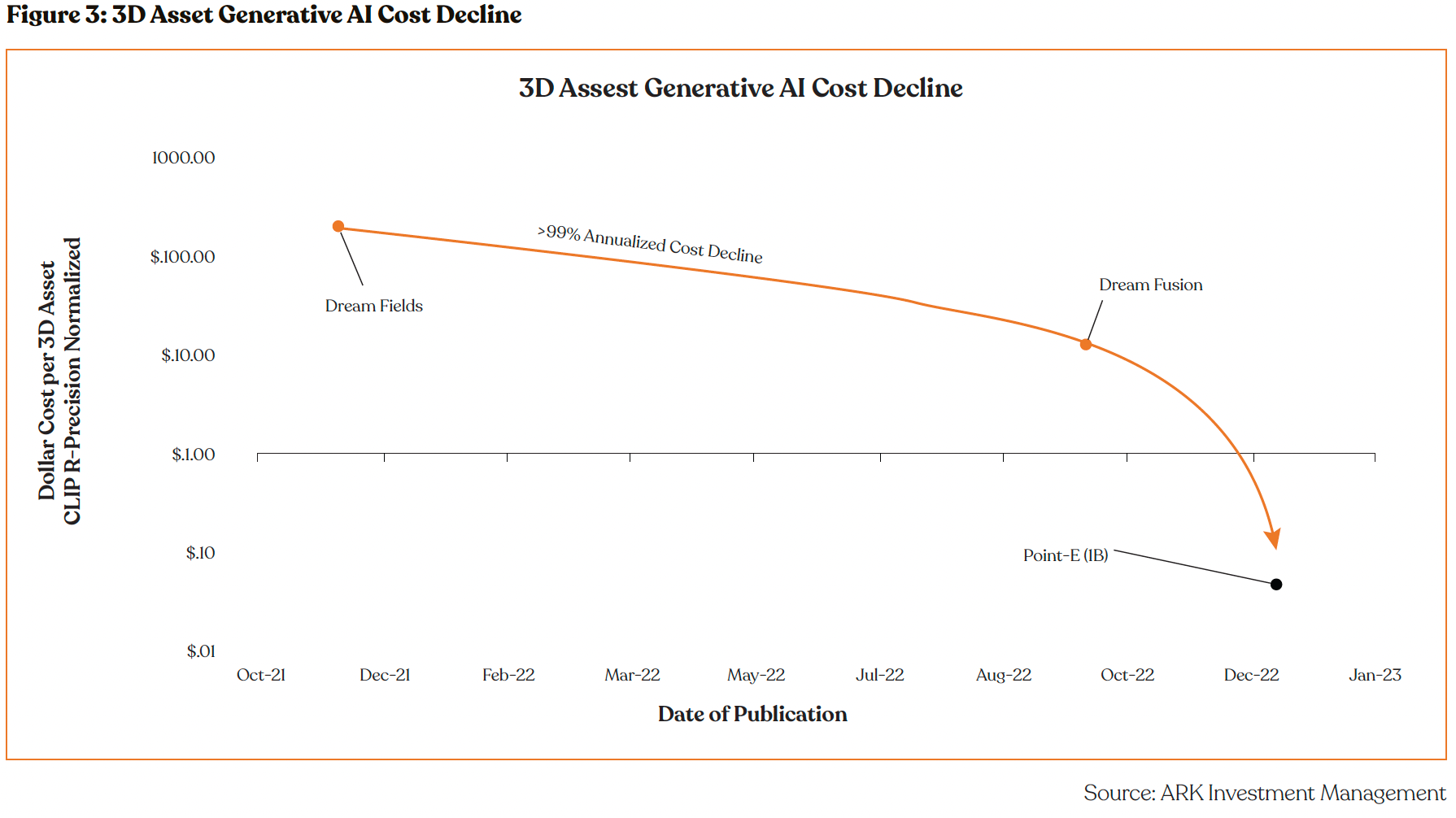
However, the current models still produce single, unified outputs, requiring manual fragmentation by game artists and developers to create dynamic game assets. In the near future, game engines are expected to integrate with text-to-3D models, enabling creators and developers to generate and edit assets seamlessly within their ecosystem. These advancements in text-to-3D generative AI mark a crucial turning point for the gaming industry, hastening the widespread adoption of generative AI in gaming.
Unity, a leading software company used by 70% of mobile games, is strategically integrating generative AI into games. According to Unity CEO John Riccitiello, it has the potential to drive 10X growth in the gaming industry. Looking ahead, we expect generative AI to permeate multiple aspects of game development and not just in-game content. By doing so, generative AI start-ups can transform game development and expand the frontier.**
-The MVR Team
Disclaimer